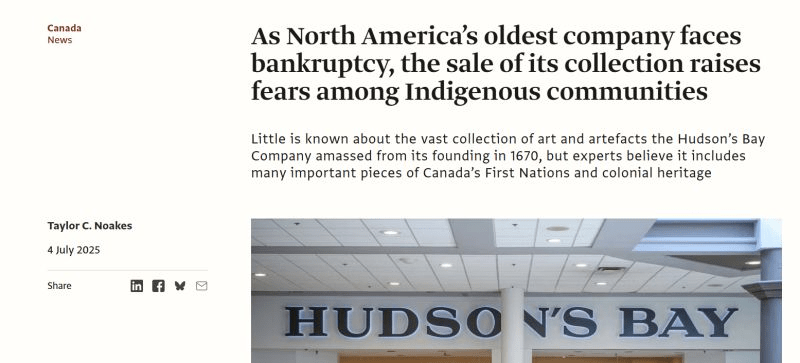
As reported by Taylor C. Noakes in The Art Newspaper just after Canada Day last week, we learned the Hudson’s Bay Company is preparing to liquidate its corporate art and artifact collection. An estimated 4,400 objects are likely to include ceremonial items, intercultural gifts, trade goods, and possibly sacred belongings of Indigenous nations.
But this isn’t just a bankruptcy story.
It’s a sovereignty story.
It’s a public trust story.
It’s a story of who gets to decide what Canada’s heritage is, and who it belongs to.
HBC was not just a company. For over 200 years, it acted as the de facto government across Rupert’s Land, negotiating on behalf of the British Crown, building forts and trade routes, and mediating power with Indigenous nations long before Canada existed as a country.
I recently read The Company by Stephen R. Bown, which traces the astonishing reach and political weight of HBC in early colonial history. If you’ve read it, you’ll know: Calling these artifacts “corporate assets” is erasure of the Indigenous agency, relationship, and resistance embedded in them.
To sell them off as luxury collectibles, without public transparency or Indigenous consent, is to treat the scars and ceremonies of this land like stockroom inventory.
These are not just relics.
They are cultural property.
They belong in public trust—and in some cases, they may belong home.
Who owns history when the Hudson’s Bay Company goes bankrupt?
Time to Read:
1–2 minutes
 EMC³ Consulting
Leave a comment