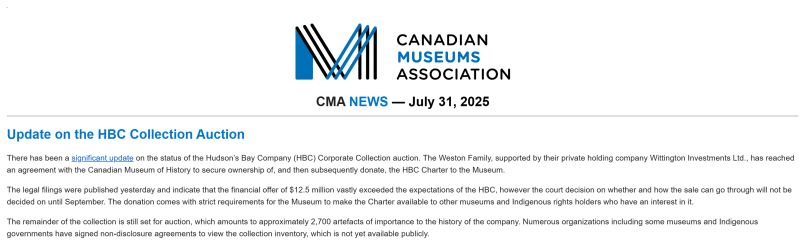
The media and the Canadian Museums Association | Association des musées canadiens have informed us today that the 1670 Royal Charter of the Hudson’s Bay Company has been spared from the auction block. The Weston family has stepped in with a $12.5 million purchase and will donate it to the Canadian Museum of History. It’s a good outcome for public access, and for those of us who feared this foundational document might disappear into a private vault.
But let’s not forget: over 2,700 artifacts from the HBC Collection remain scheduled for sale. That includes point blankets, colonial-era ledgers, and items of deep cultural and archival significance. Many are intertwined with Indigenous histories, and yet, access to even viewing the list requires a non-disclosure agreement.
We’re right to breathe a sigh of relief today. But, while we celebrate this preservation milestone, we also need to ask:
📌 What kind of precedent are we setting when the protection of cultural heritage depends on individual philanthropy rather than shared responsibility?
📌 Why does it take a billionaire to rescue something so vital to public memory?
📌 And what does it mean when that billionaire family is under fire for keeping grocery prices high?
This donation may be generous, but it’s also strategic. Cultural philanthropy can soften reputational edges. A $12.5 million gift is a fraction of what’s been gained through price markups and wage stagnation.
This isn’t a critique of the museum; it’s a call to examine the structures that shape access, ownership, and legacy. Do we want a future where our history depends on who has the deepest pockets? Or one where cultural stewardship is a shared, equitable responsibility?
It is good.
It is not enough.
Not just rescue acts—systems change.
An Update: Hudson’s Bay Charter Saved, But At What Cost?
Time to Read:
1–2 minutes
 EMC³ Consulting
Leave a comment