Municipalities are often the first and last line of defence for our shared heritage. Not just the headline-making events like battles or nation-building moments, but the quieter, local stories that shape identity: community halls, family homes, corner museums, drill halls, and regional archives.
Lately, I’ve been watching three cases unfold in real time, each telling a very different story about what we value — and what we’re willing to lose.
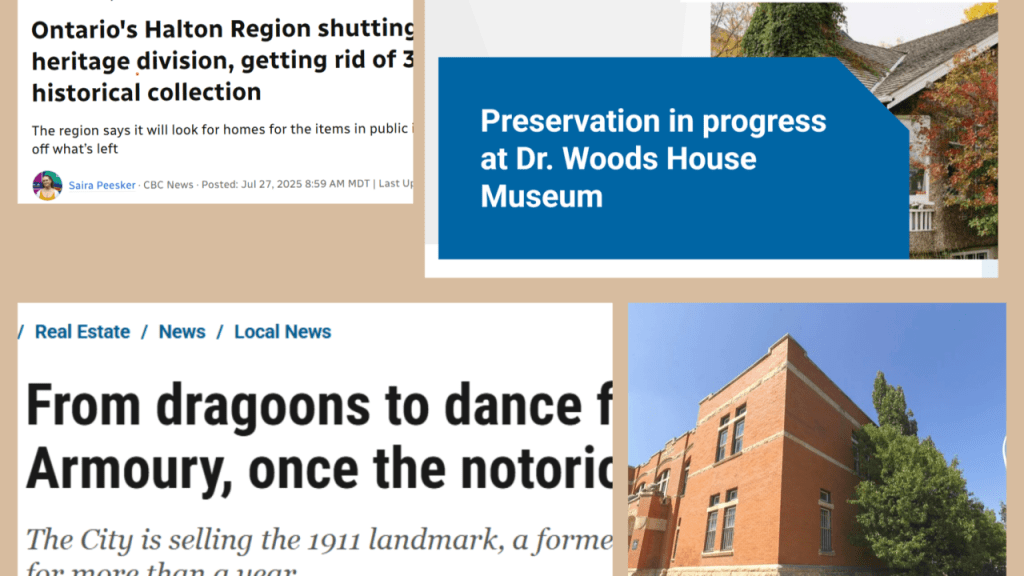
In June 2025, Ontario’s Halton Region voted to shut down its heritage services entirely, eliminating six full-time positions and transferring or dispersing its 14,000-item historical collection. The reason? Councillors cited “scope creep,” arguing that heritage work had become a regional burden that would be better left to local municipalities.
This decision comes despite a robust, professionally managed collection and a history of community engagement. What’s more concerning is that there is no binding plan in place to ensure the public accessibility or safety of these assets. The collection will be offered to local museums, but only if they have capacity, and many don’t. What doesn’t get picked up may be sold off or lost.
This is an example of administrative offloading, where the responsibility of memory is shifted without resourcing, coordination, or long-term accountability. And once it’s gone, it’s gone.
🏛️ Edmonton: Selling the Armoury
On the other side of the country, the City of Edmonton quietly listed the Connaught Armoury for sale this spring. It’s a designated Municipal Historic Resource and the only remaining example of a drill hall of its type in Alberta, having once been used for militia training and later serving as the home of Indigenous groups and community organizations. Now, it’s just “surplus inventory.”
No formal heritage strategy preceded the listing. No future use plan was offered. Its historical significance (linked to Canada’s military past, Edmonton’s early development, and its cultural reuse by artists and community members) is being reduced to a real estate listing.
This is monetized offloading—when built heritage is seen not as an asset to nurture, but a liability to dispose of.
🏠 Leduc: Choosing a Different Path
And then there’s Dr. Woods’ House Museum in Leduc. A modest heritage home with local significance, once at risk of closure, is now part of a municipal heritage strategy-in-development.
Instead of shuttering the site, Leduc has taken a different route: investing in community engagement, feasibility planning, and open discussion about what the site could become, not as a relic, but as a platform for shared storytelling. They’re not clinging to nostalgia. They’re asking the right question: how might this site serve the public now?
Oh, and let’s not forget to mention that the City of Leduc launched an award-winning communication strategy to share the work with residents.
This is transformative stewardship: acknowledging heritage as a living system, not a frozen past.
What Happens When We Stop Caring for Our Heritage?
When municipalities offload heritage responsibilities—whether to save costs, shift blame, or simplify operations—we risk far more than vacant buildings or orphaned artifacts.
We lose infrastructure for identity.
We silence complex histories.
We close doors on reconciliation, inclusion, and public dialogue.
This is what I mean by heritage dissonance: the growing gap between the values we claim to hold (history, belonging, civic pride) and the choices we actually make when budgets tighten or attention shifts.
The Counterpoint: Heritage as a Systemic Asset
Heritage, when integrated meaningfully, can do heavy lifting:
- It supports truth-telling and reconciliation with Indigenous communities.
- It attracts cultural tourism and economic development.
- It anchors neighbourhood identity and social cohesion.
- It offers youth a sense of place and continuity.
But this requires more than a plaque or a line item. It demands systems change—a shift in how we plan, fund, and value cultural memory in our cities.
We need to do better.
Fortunately, some communities are already showing us how.
Let’s learn from them, and ask the hard questions before the buildings are sold, the archives emptied, and the stories lost.
 EMC³ Consulting
Leave a comment