A reflection on community connection, cultural placemaking, and economic responsibility
There is an assumption built into many percent-for-art programs that bigger is better.
Bigger budgets.
Bigger objects.
Bigger gestures.
Bigger permanence.
We have learned to equate scale with seriousness and monumentality with value. If a work is not physically imposing, technologically complex, or structurally permanent, it is often treated as less legitimate, less ambitious, less “impactful.”
That assumption is quietly being challenged.
A recent Toronto Star article describes public art in Toronto as facing an “uncertain and precarious future,” driven by rising construction costs, changes to provincial planning rules, and shrinking funding pools (Hasham, 2025). Fewer large installations. Smaller budgets. More competition for community benefits funding. Greater scrutiny of maintenance and repair.
At first glance, this reads like a crisis.
It may be more of a correction.
Because public art was never meant to be an arms race.
It was intended to be civic infrastructure: culturally responsive, socially accountable, and economically responsible.
Right now, scale is doing too much of the talking.
What Do We Mean by Cultural Placemaking?
Before going further, it helps to define the terms we keep using.
Cultural placemaking refers to the intentional integration of arts, culture, and creativity into the planning and design of public spaces to strengthen social connection, reflect local identity, and support community well-being. It is not about inserting art into space after the fact; it is about shaping space through culture.
Community-rooted public art means work that:
- Emerges from local context and lived experience
- Is shaped with community, not merely installed for it
- Reflects ongoing relationships rather than one-time transactions
- Values process as much as product
This is a fundamentally different approach from monument-based public art. It prioritizes belonging over spectacle.
The Dissonance: What We Say Public Art Is vs. What We Ask It to Do
We say public art should:
- Belong to communities
- Reflect on place and identity
- Be accessible and welcoming
- Support local artists
- Create shared meaning
But we fund it as if it must also:
- Anchor real-estate branding
- Perform architectural spectacle
- Absorb construction inflation
- Carry technological risk
- Justify million-dollar price tags
These goals are not compatible.
When public art is treated primarily as development infrastructure, it ceases to be public in any meaningful sense. It becomes a marketing device with cultural aesthetics. That is not inherently wrong, but it is a different function than community-rooted cultural investment.
And confusing those two functions is how budgets balloon while connections shrink.
Cultural Placemaking Tells Us Something Different
Decades of research on cultural placemaking point to a different definition of impact.
The Project for Public Spaces emphasizes that successful public places are defined less by monumental objects and more by sociability, comfort, accessibility, and local identity (PPS, 2016).
Markusen and Gadwa’s foundational work on creative placemaking shows that cultural interventions generate the strongest outcomes when they:
- Are embedded in community priorities
- Support local creative labour
- Strengthen social cohesion
- Contribute to long-term neighbourhood vitality (Markusen & Gadwa, 2010)
UNESCO reinforces this perspective, arguing that culture is most effective when treated as a participatory process rather than as a static product installed into space (UNESCO, 2016).
In other words, placemaking is relational, not monumental.
The most effective public art is not necessarily the most expensive.
It is the most contextually rooted.
Smaller does not mean weaker
The Toronto Star article suggests that a future of fewer monumental works may open space for:
- Temporary installations
- Integration into civic infrastructure
- More artist experimentation
- More community-specific projects (Hasham, 2025)
This doesn’t frighten me; I see this as a strategic recalibration.
Research in placemaking consistently shows that people engage more deeply with projects that:
- Are locally specific
- Reflect lived experience
- Invite participation
- Evolve over time (PPS, 2016; Markusen & Gadwa, 2010)
Connection, not spectacle, is what sustains cultural relevance.
A Living Example: Edmonton’s Child-Friendly Public Art
We do not have to imagine what this looks like in practice. Edmonton offers a compelling example.
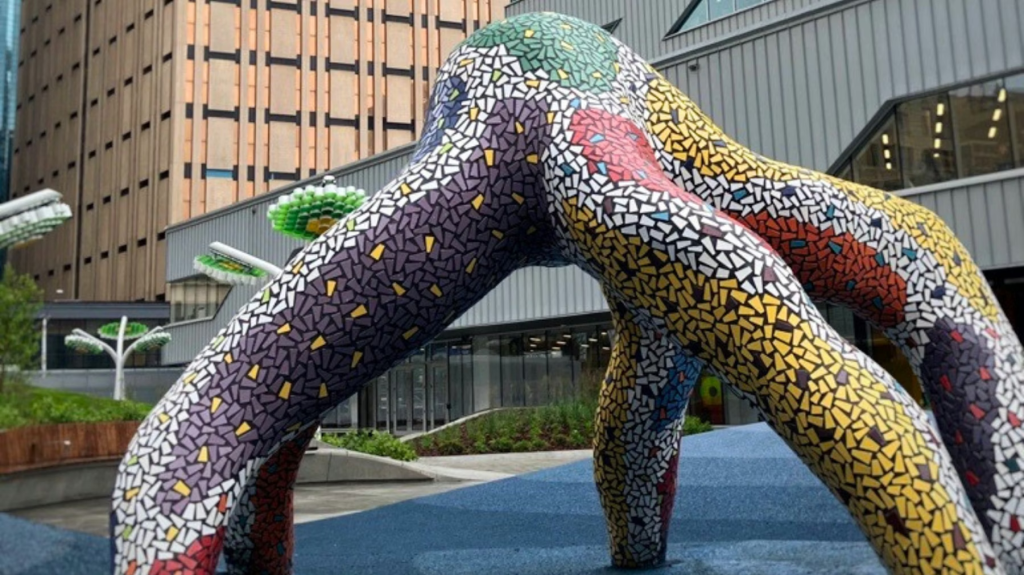
The recently highlighted, national award-winning child-friendly public art installations, A Mischief of Could (Be)s and UGO by Red Knot Studio (Erin Pankratz and Christian Pérès Gibaut), are designed to spark imagination, play, and intergenerational engagement. Rather than functioning as a singular monumental object, the works are:
- Interactive
- Scaled to human experience
- Embedded in everyday use
- Designed for accessibility and delight
They invite participation rather than observation. They build attachment through experience rather than awe. They prioritize presence over permanence.
This is cultural placemaking in action.
And it demonstrates that impact does not correlate with size or cost, but with relationship and relevance.
Monumentality Is Not a Neutral Aesthetic Choice
Large, permanent public artworks carry hidden economic consequences:
- Escalating fabrication costs
- Engineering complexity
- Long-term maintenance liabilities
- Technological obsolescence
- Concentrated financial risk
The Toronto Star documents:
- Works that tripled in cost
- Installations requiring millions in repairs
- Technologically complex pieces that failed to function as intended
- Artworks never activated due to governance or safety concerns (Hasham, 2025)
Let me be clear, this failure is not artistic: it’s procurement.
No other public infrastructure category accepts this level of cost volatility without questioning the model.
But monumentality is not only an economic problem.
It is also a cultural one.
The preference for significant, permanent, singular objects in public space comes directly from European traditions of power-making: statues, triumphal arches, imperial markers, and commemorative monuments designed to assert dominance, permanence, and authority. Monumentality was never about community. It was about control. About whose story was allowed to occupy space, and whose presence was rendered invisible.
When we reproduce that model uncritically, we reproduce its logic.
Alongside economic risk, monumentality carries cultural consequences:
- Centralized authorship
- Singular narratives
- Limited community agency
- Fixed meaning in dynamic spaces
- Power encoded in permanence
Many Indigenous and community-based cultural traditions understand art differently: as process, as ceremony, as relationship, as seasonal, as responsive, as shared stewardship rather than singular authorship. Value is created through continuity, reciprocity, and presence, not dominance.
When public art insists on being monumental, it quietly excludes these epistemologies. It becomes harder for temporary work, land-based practices, oral traditions, community storytelling, and relational art forms to be recognized as legitimate cultural infrastructure.
So when we say this model is economically unsustainable, we are only naming half the problem.
It is also culturally extractive.
It concentrates land, capital, and attention into objects that serve institutional legitimacy more than community life. It prioritizes what can be owned, insured, and branded over what can be held, shared, and renewed.
Smaller, community-rooted, temporary, and relational public art is not a compromise.
It is a re-orientation.
Away from colonial permanence.
Toward living culture.
Responsible Procurement Is Cultural Stewardship
In every other infrastructure domain, public procurement is expected to be:
- Risk-aware
- Lifecycle-costed
- Context-appropriate
- Scalable
Public art should be no different.
Smaller-scale, community-embedded work allows:
- Distributed investment instead of concentrated risk
- Participation by more artists
- Greater cultural diversity
- Stronger place specificity
- Lower long-term fiscal exposure
This is stewardship.
And it aligns directly with best-practice frameworks in cultural placemaking, which emphasize sustainability, local capacity building, and social return rather than one-time spectacle (Markusen & Gadwa, 2010; UNESCO, 2016).
Public Art Is an Economic Investment, Not a Decorative Expense
Public art activates:
- Cultural labour markets
- Local fabrication industries
- Tourism flows
- Public-realm engagement
- Place-based economic behaviour
But economic return does not require monumentality. It requires relevance.
Placemaking research shows that people stay longer, return more often, and engage more deeply in spaces where they feel represented and welcomed (PPS, 2016). That behavioural shift is economic.
Public art’s value is not in its size.
It is in its capacity to create a sense of belonging.
the percent-for-art trap
Percent-for-art programs were never intended to create a market for massive standalone sculptures. They were meant to ensure development contributed to cultural life.
Over time:
Percent became expectation.
Expectation became monumentality.
Monumentality became the default.
Now the system struggles to fund:
- Artist retention
- Studio space
- Temporary programming
- Community-based processes
- Cultural infrastructure
We built a pipeline for objects and under-resourced the ecosystem that produces them, creating a fundamental design problem.
my lens
I work in cultural systems and public-sector procurement. I see how often public art is expected to absorb economic risk that no other infrastructure category would accept. I see projects become financially fragile not because they lack merit, but because they are structurally oversized relative to their purpose.
I have worked with heritage buildings, museums, and cultural centres, tasked with preserving nationally significant assets, on projects with budgets smaller than the contingency line for a single sports facility. The message is not subtle: culture is expected to be grateful for survival, not supported for growth.
The contrast is visible in real time: tens of millions committed to sports infrastructure, while cultural infrastructure is asked to survive on incremental, short-term funding.
I also see something else. The most successful projects are rarely the most expensive ones. They are the ones that:
- Begin with the community
- Work with local artists and fabricators
- Use durable, legible materials
- Build narrative rather than spectacle
Smaller projects make space for more voices.
More stories.
More responsibility.
Maturity
An “uncertain and precarious future” may be precisely what public art needs to release itself from:
- Monumentality as default
- Development-driven aesthetics
- Capital risk as cultural legitimacy
A smaller, more community-rooted, and more economically literate public art ecosystem is not a downgrade.
It is a return to purpose.
Final thought
Public art is not successful because it is large.
It is successful because it belongs.
If public art is to survive, it must stop trying to impress capital
and start serving the community.
Smaller scale.
Stronger connection.
Smarter investment.
Public art doesn’t need saving.
It needs structures to align its procurement with what it was meant to be.
References
Hasham, A. (2025, December 28). Toronto’s public art faces an “uncertain and precarious future.” Why that might just end up saving it. Toronto Star.
Markusen, A., & Gadwa, A. (2010). Creative Placemaking. Washington, DC: National Endowment for the Arts.
Project for Public Spaces (PPS). (2016). What Makes a Great Place? https://www.pps.org/article/grplacefeat
UNESCO. (2016). Culture: Urban Future – Global Report on Culture for Sustainable Urban Development. Paris: UNESCO.
Canadian Chamber of Commerce, Business Data Lab. (2025). Artworks: The Economic and Social Dividends from Canada’s Arts and Culture Sector.
Statistics Canada. Culture Satellite Account (CSA).
 EMC³ Consulting
Leave a comment