
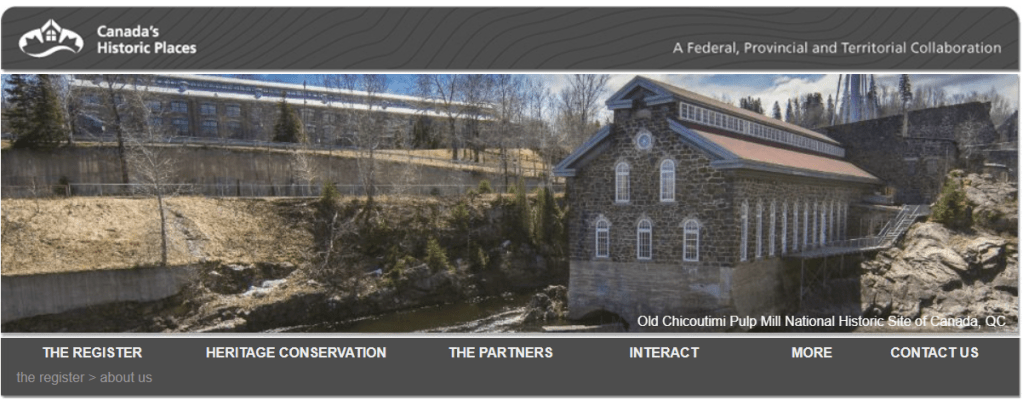
The quiet dismantling of Canada’s heritage infrastructure
By the time this spring arrives, the Canadian Register of Historic Places will be gone. No archive. No successor platform. No national point of reference.
For those outside the heritage field, this may sound like a technical housekeeping issue. A website reaching the end of its technological life. An IT problem, not a cultural one.
That reading is wrong.
The Register, launched in 2004 as part of a pan-Canadian collaboration, is not just a website. It is the connective tissue of Canada’s heritage system. More than 13,000 historic places are documented there, recognized by federal, provincial, territorial, and municipal authorities. It is where designations meet context. Where local stories are legible at a national scale. Where researchers, planners, appraisers, developers, policymakers, educators, and consultants like me begin our work.
And now, it is being quietly unplugged by Parks Canada with no replacement planned.
A “one-stop shop” that actually worked
In reporting by CBC News, Prince Edward Island heritage officer Sarah Bulman describes the Register as “very helpful” and its loss as “a real loss.” That is professional understatement.
The Register did something deceptively simple and profoundly important: it allowed users to search across jurisdictions. A single query could surface related sites in P.E.I., New Brunswick, Nova Scotia, or beyond. That matters because heritage does not respect provincial borders. Settlement patterns, trade routes, migration corridors, and cultural landscapes spill across lines drawn on maps.
Without the Register, a basic comparative question now becomes an obstacle course. One provincial database here. Another there. In some cases, no public database at all, only informal requests to overextended heritage officers. This is not efficiency. It is fragmentation by design.
P.E.I. is comparatively lucky. The province mirrored federal entries in its own database years ago and can now fall back on that infrastructure. Other jurisdictions relied on the Register as their system of record. For them, the loss is not just inconvenient. It is destabilizing.
From shared infrastructure to data orphanage
According to the National Trust for Canada, provinces and territories invested millions of dollars to build the Register as part of the Historic Places Initiative. The response to its decommissioning has been described as “shock and disappointment,” which again feels polite given the stakes.
What is being offered instead is, frankly, inadequate. Jurisdictions will receive Excel spreadsheets of their listings. No images. No public interface. No cross-jurisdictional functionality. Heritage reduced to a data dump, stripped of narrative, context, and accessibility.
This is an erasure of shared meaning.
The consequences of this are predictable:
- Information about historic places becomes fragmented, inconsistent, and harder to find.
- Public visibility declines, quietly undermining public value.
- Comparative analysis across regions becomes difficult or impossible.
- Policy, planning, and investment decisions lose a shared evidentiary base.
In short, the system still exists in theory, but not in practice.
Heritage as infrastructure, not ornament
There is an uncomfortable pattern here. When budgets tighten, or platforms age out, heritage infrastructure is treated as optional. A “nice to have.” A cultural ornament rather than a functional system.
Yet the Register was used for very practical purposes: assessing demolitions, informing land-use planning, supporting real estate due diligence, guiding conservation investments, and educating the public. It underpinned decisions with real financial, legal, and social consequences.
If a national transportation database vanished overnight, we would not accept a spreadsheet and a shrug. If an environmental registry disappeared, there would be uproar. Heritage, however, is expected to absorb the loss quietly, with resilience and goodwill.
The dissonance is telling.
What is actually at risk
My concern is not nostalgia for an old website. It is concern about what happens when shared systems disappear without replacement.
Heritage work depends on continuity. On comparability. On the ability to situate local significance within broader national patterns. When that scaffolding collapses, the burden shifts downward to municipalities, consultants, and volunteers who already operate with limited resources.
Research becomes slower and more expensive. Errors increase. Important places become invisible simply because they are harder to find. And once visibility is lost, protection often follows.
A closing thought, and a pointed one
The Register was created to foster “a culture of heritage conservation in Canada.” Decommissioning it without a successor does the opposite. It signals that coordination is optional, that national context is expendable, and that decades of collaborative investment can be sunsetted without a plan.
This is not just a technical failure. It is a systems failure.
If Canada is serious about heritage as a public value rather than private sentiment, then maintaining shared infrastructure is not optional. It is the work.
And right now, that work is being quietly undone.
 EMC³ Consulting
Leave a comment